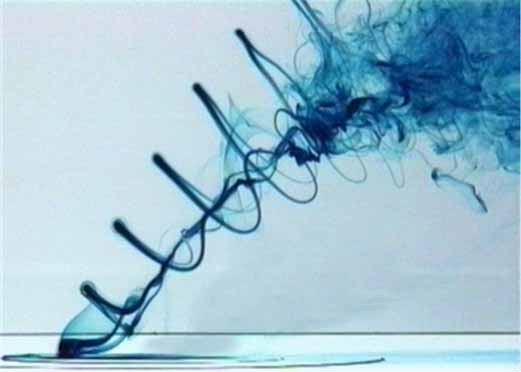
In fluid dynamics, turbulence or turbulent flow is a flow regime characterized by chaotic and stochastic[citation needed] property changes. This includes low momentum diffusion, high momentum convection, and rapid variation of pressure and velocity in space and time. Nobel Laureate Richard Feynman described turbulence as "the most important unsolved problem of classical physics."[1] Flow in which the kinetic energy dies out due to the action of fluid molecular viscosity is called laminar flow. While there is no theorem relating the non-dimensional Reynolds number (Re) to turbulence, flows at Reynolds numbers larger than 5000 are typically (but not necessarily) turbulent, while those at low Reynolds numbers usually remain laminar. In Poiseuille flow, for example, turbulence can first be sustained if the Reynolds number is larger than a critical value of about 2040;[2] moreover, the turbulence is generally interspersed with laminar flow until a larger Reynolds number of about 3000. In turbulent flow, unsteady vortices appear on many scales and interact with each other. Drag due to boundary layer skin friction increases. The structure and location of boundary layer separation often changes, sometimes resulting in a reduction of overall drag. Although laminar-turbulent transition is not governed by Reynolds number, the same transition occurs if the size of the object is gradually increased, or the viscosity of the fluid is decreased, or if the density of the fluid is increased.
 |
| Turbulence in the tip vortex form an airplane wing |
 |
Flow visualization of a turbulent jet,
mad by laser-induced fluorescence.
Thr jet exhibits a wide range of length scales,
an important characteristic of turbulent flwos. |
http://en.wikipedia.org/wiki/Turbulence